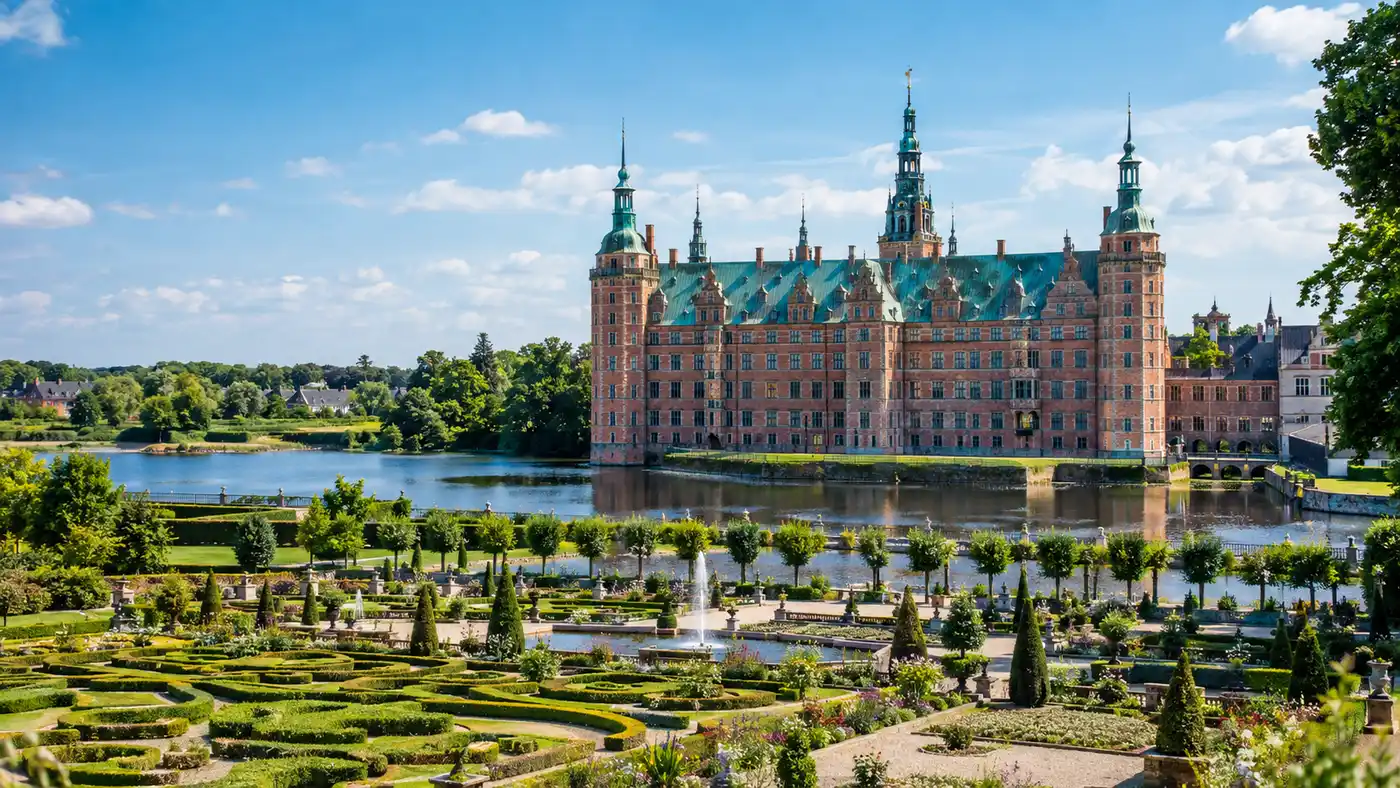
Frederiksborg Castle Gardens and Baroque Park
Most visitors rush through the palace gates, buy their tickets, and spend three hours staring at gilded ceilings and Danish portraiture. I did that on my first visit. It was exhausting. By the time I wandered out back to explore the frederiksborg castle gardens, my legs felt like lead, the afternoon light had gone flat, and the park was already starting to empty. Do not make that mistake. The grounds behind the fortress deserve just as much time as the Renaissance halls inside, if not more.
Spread across the rolling terrain north of the lake, this landscape is really two distinct worlds stitched together. On one side sits a rigid, symmetrical Baroque showpiece designed to bend nature to the will of an absolute monarch. Right next to it lies a sprawling English-style romantic park full of winding paths, weeping willows, and quiet ponds. You can move from razor-sharp boxwood hedges to overgrown woodland within five minutes of walking. Best of all, unlike the museum itself, wandering the grounds will not cost you a single krone.
Book your frederiksborg castle experience:
The Royal Symmetry of the Frederiksborg Castle Gardens
The formal garden drops down toward the water like an emerald staircase. It was originally laid out in the 1720s by Johan Cornelius Krieger, the court architect for King Frederik IV. Frederik had toured Italy and France, fell in love with grand symmetrical landscaping, and wanted something to show foreign diplomats that Denmark understood modern courtly taste. It was an enormous flex of royal power. Water was channeled through pipes, entire hillsides were leveled, and thousands of trees were chopped down to create sweeping sightlines.
For roughly a century, the parterre actually vanished. Nature took it over in the 1800s because maintaining royal French-style gardens was astronomically expensive, especially after Denmark went through severe financial crises. Grass swallowed the terraces, and the crisp geometry blurred into standard pasture. What you see today is an obsessive modern reconstruction finished in 1996. Landscape historians combed through Krieger's original 18th-century sketches, measured soil depths, and replanted roughly 65,000 boxwood shrubs and dozens of lime trees to bring the 1725 layout back to life.
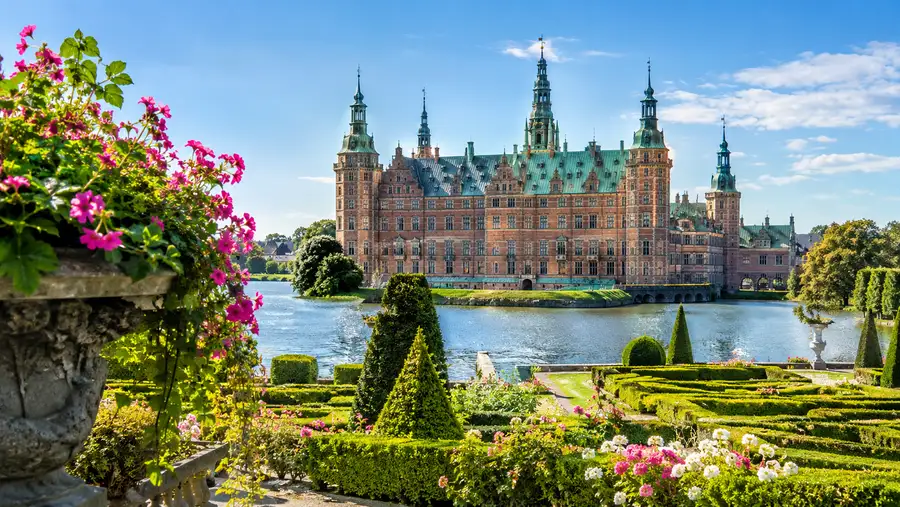
Stand at the bottom terrace near the lake edge and look up. Four distinct levels rise up the slope, centered on a noisy cascade of artificial waterfalls. Boxwood hedges are clipped into royal monograms, showing the ciphers of Frederik IV, Christian VI, Frederik V, and Queen Margrethe II. The symmetry can feel a little strict, maybe even clinical, if you look at it too long under midday sun. When the morning mist rises off Slotsøen, the sharp lines soften up nicely.
Pro tip: Climb up to the very top terrace where the water reservoir feeds the cascade. From that highest bench, you get the classic postcard angle looking straight down the central axis directly into the rear facade of the castle.
Water drives the whole visual drama here. The cascade features carved stone heads spitting water down stone steps, framed by small bubbling fountains on the lower parterre lawns. On windy autumn afternoons, the spray blows right across the central gravel paths. Bring a shell jacket if the weather looks dicey.
Wandering the Romantic Park of Frederiksborg Castle
Turn left or right out of the clipped hedges, and the park of frederiksborg castle changes character completely. Toward the end of the 1700s, European monarchs grew tired of walking along ruler-straight avenues. They wanted drama, sentimentality, and manufactured wilderness. Frederik VII took a big chunk of the surrounding royal forest and reshaped it into a Romantic English garden with winding gravel paths, tiny wooden bridges, and deliberately rustic tree clumps.
Tucked away in the western section sits Badstuen, the Bath House. It looks like a miniature fairy-tale hunting lodge with octagonal towers and a copper spire, built way back in 1581 by Frederik II. Unlike the main castle, the Bath House feels intensely private. It sits quietly against a small canal, surrounded by old beeches and weeping willows that trail their branches straight into the dark green water. The royal family still uses it occasionally for royal hunts, so you cannot go inside, but peering at it through the trees is one of the best walks in the entire complex.
I like this side of the park better than the formal parterre. It feels human. Local joggers from Hillerød loop past on their 5k routes, retirees sit on weathered wooden benches reading paperbacks, and mallards paddle aggressively toward anyone who pauses too long near the water. There is a sense of calm here that disappears completely inside the crowded portrait galleries of the museum.
The English garden stretches much further north than most people realize. If you follow the main canal past the Bath House, you hit the Lake of the Bath House (Badstuedammen) and the deer park trails leading toward Louise Island. Louise Island was built as a private romantic hideaway for King Frederik VII and his third wife, Countess Danner, complete with a tiny faux-Norwegian log cabin. It is usually closed off to preserve bird nesting, but the view across the water makes you feel like you are deep in rural Scandinavia rather than twenty minutes from a suburban train station.
Walking Routes and Layout of the Grounds
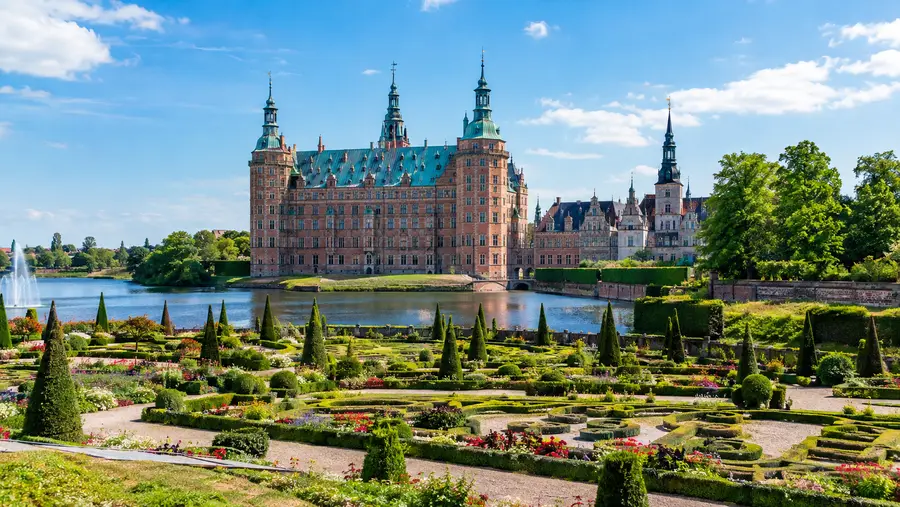
Navigating the grounds is straightforward once you understand how the lake anchors the topography. The castle sits on three small islets out in the water, connected by stone bridges. The formal gardens sit directly north on the opposite shoreline, while the English park wraps around the northern and western perimeter. You do not need to buy admission tickets for Frederiksborg just to explore the outdoors. The park gates stay unlocked throughout daylight hours year-round.
If you have limited time or energy, pick your route carefully. You can walk around the lake in about 45 minutes, but adding the upper terraces and the outer woodland loops easily stretches the walk to two hours. The gravel paths are mostly smooth, though pushing a stroller up the steep Baroque steps requires some sweat.
| Garden Section | Design Style | Key Attraction | Terrain & Pace |
|---|---|---|---|
| Lower Parterre | French Baroque | Royal monograms, fountains | Flat gravel paths, easy stroll |
| Upper Terraces | Terraced Cascade | Stone waterfalls, panoramic view | Steep stone stairs, moderate climb |
| Bath House Grounds | English Landscape | Badstuen lodge, scenic canals | Gently rolling, dirt & gravel paths |
| Slotsøen Loop | Lakeside Promenade | Water-level castle reflections | Completely flat, steady walking pace |
To get the most out of your legs, structure your visit so you do not backtrack over the same gravel twice. Here is how I usually map it out for friends:
- Start at the main gate: Walk through the castle courtyards first to absorb the red brick scale before crossing the northern bridge into the gardens.
- Head up the western flank: Take the tree-lined path up past the Bath House early while the morning light reflects off the side canals.
- Cross the upper reservoir: Walk behind the water supply of the cascade to soak in the grand central vista of the entire estate.
- Descend the formal parterre: Come down the stairs slowly, right through the clipped hedges and boxwood monograms.
- Finish along the eastern lake path: Walk the perimeter trail along the east shore to catch the low sun hitting the palace windows.
Note: Stone stairways along the Baroque cascade become slick when wet, and they stay frozen well into mid-morning during the colder winter months. Use the gentle flanking gravel ramps if you are visiting between November and March.
If you want to head inside after your walk, take a breather first. The transition from peaceful outdoor trails to echoing museum chambers can feel abrupt. You can spend an entire afternoon wandering the halls, so check our breakdown of what to see inside Frederiksborg Castle before you commit your energy to the museum galleries.
Book your frederiksborg castle experience:
Best Times to Visit the Frederiksborg Castle Gardens
Danish weather is notoriously moody, and it completely dictates how this park feels. In June, the lime trees smell sweet, the lawns are blindingly green, and the water cascade runs at full volume. You can lounge on the grass for hours without a jacket. Late spring brings out thousands of blooming perennials along the borders of the romantic garden.
Autumn might actually be better. By mid-October, the old beeches surrounding Badstuen turn deep copper and gold. When the water in the lake is calm, the reflection of the crimson castle bricks against the gold foliage is unbelievable. You also miss the tour bus crowds that jam the gravel paths in July and August. On a crisp October Tuesday, you might share the entire upper terrace with three other people and a couple of noisy crows.
Winter has its own austere charm. The cascade gets shut off in late autumn so the pipes do not burst when temperatures drop below freezing, which strips away the sound of rushing water. When snow dusts the clipped boxwoods of the parterre, the geometric patterns stand out sharper than they do in midsummer. It looks like an architectural blueprint drawn across the earth.
Keep these timing factors in mind before hopping the train:
- The fountain season: The water cascade only operates between May 1st and the end of September, generally running from 10:00 to 17:00 daily.
- Light conditions: Morning light hits the front courtyards, while late afternoon gives you the best golden glow across the rear gardens and the parterre.
- Gate closures: The grounds open at 07:00, but closing times follow the sunset, shutting as early as 16:00 in December and staying open until 21:00 in midsummer.
If you are catching an early morning train from central Copenhagen, you can be walking past the lake before nine. The light then is soft, the castle cafe is not open yet, and the silence across the water is pure magic.
Picnics, Small Ferries, and Local Quirks
Eating in the park of frederiksborg castle is one of life's simple pleasures, provided you plan ahead. The cafe inside the castle stables serves decent smørrebrød, but it fills up fast and costs a fair chunk of money. Bringing your own provisions is a much better call. Stop by one of the bakeries near the Hillerød train station, grab a cardboard box of warm cinnamon pastries or seeded rye sandwiches, and carry them down to the park.
Picnics are fully permitted on the lawns throughout the English landscape garden, but do not spread a blanket inside the formal Baroque parterre. Park wardens are very strict about protecting the low boxwood hedges and fountain borders from foot traffic. Stick to the open grass near the western canals or the benches facing Slotsøen.
Between May and mid-September, a tiny wooden ferry called Frederiksborg Slotssøfart chugs across the water. It has been running since the mid-20th century. The captain putters the boat from the town square (Torvet) over to the castle landing and then across to the formal gardens. It costs around 40 Danish kroner for an adult, cash or MobilePay preferred, and takes about 15 minutes to cross. Watching the Renaissance spires drift by from water level while the little diesel engine hums is worth every single coin.
If you have an extra hour, walk beyond the northern fence line into the Jægerbakken woods. Few tourists bother heading up the slope. The trees here are tall and old, shielding small trails where town locals walk their dogs away from the manicured lawns. You will stumble across an old stone obelisk erected in 1788 to celebrate agricultural reforms that freed Danish peasants from feudal bondage. It is an unexpected slice of social history hiding in the woods behind an opulent royal pleasure ground.
Frequently Asked Questions about frederiksborg castle gardens
Are the Frederiksborg Castle Gardens free to enter?
Yes. The formal Baroque garden and the surrounding English landscape park are public parks open every day of the year with completely free admission. You only need a ticket if you plan to go inside the castle museum itself.
Can you bring dogs into the gardens?
Dogs are allowed throughout the park grounds, but they must be kept on a short leash at all times. They are not permitted inside the museum buildings or inside the castle courtyards.
When do the fountains and cascade run?
The fountains and the stone cascade operate exclusively during the warmer months, typically from May 1st through the first weekend of October. During this season, the water runs daily from 10:00 to 17:00.
How long does it take to walk around the entire lake and park?
A simple loop around Slotsøen takes about 45 minutes at a relaxed pace. If you climb the Baroque terraces, explore the Bath House canals, and wander the English landscape paths, plan for roughly 90 minutes to two hours.
Quick Reference
- Entry fee: Free year-round
- Fountain season: May through September, 10:00 - 17:00
- Opening hours: Daily from 07:00 to sunset
- Lake ferry cost: Around 40 DKK per adult
Book your frederiksborg castle experience:
Worth the Walk?
If you travel all the way up to Hillerød just to wander through royal galleries, you are leaving the best half of the trip behind. Take the morning to inspect the historic portraits, eat a quick pastry on a quiet bench, and spend your afternoon getting lost along the winding paths of the park. That quiet contrast between rigid royal ego and cool Nordic nature is what makes this place stick in your memory long after you return home.
Read more about frederiksborg castle.